

Research
How small can a QR code be? We measured the floor
By OpenQR · updated 23 November 2026
Every QR code sizing guide eventually says "make it big enough to scan" and stops there. The honest answer is a number, and the number is not about the print's width or your link's length. It is about how many camera pixels land on each module, the little square that is one bit of the code. We measured where that number's floor sits, by rendering codes, degrading them through a synthetic camera pipeline and decoding 17,280 attempts across four open-source decoders. Below roughly 3 pixels per module, decoding collapses for everyone. Above about 3.5, everything reads. Error correction, the setting people reach for when a code will not scan, does not move that floor at all.
7 min read · Updated 23 November 2026
The cliff, measured
Our capture pipeline emulates a camera looking at a printed code: it resamples the render to a target pixels-per-module, adds the blur, noise, JPEG compression and slight rotation a real capture carries, then hands the result to four decoders (ZBar, OpenCV QRCodeDetector, OpenCV WeChat and ZXing). For each resolution level we decode 40 captures per cell and record the success rate of the worst-performing decoder, because that is the reader your audience is likeliest to be stuck with.
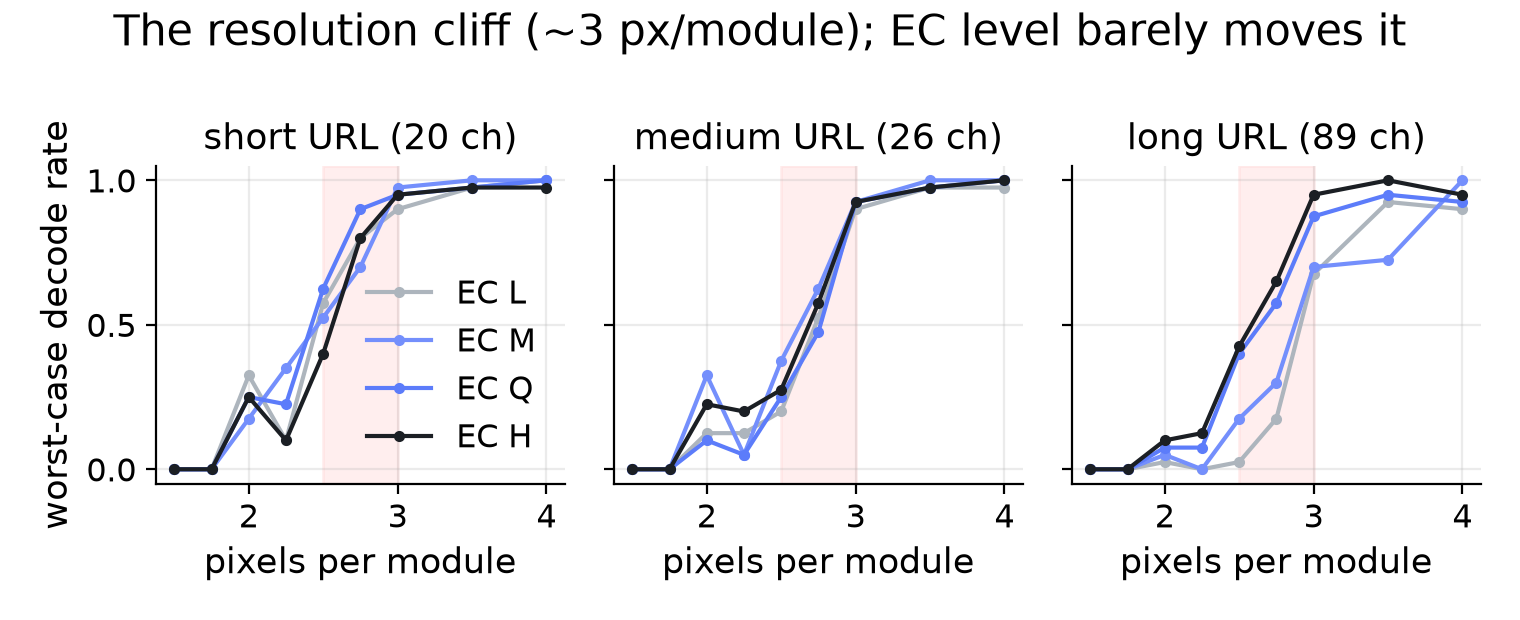
The curve is a cliff, not a slope. At or below about 1.75 pixels per module, worst-case decoding is zero. Through 2.5 it stays unreliable, 12 to 35% success. Above about 3.5 it saturates: 95% or better for every cell we ran.
Pick your reliability level before you pick a size:
| Target success (worst-case decoder) | Minimum resolution |
|---|---|
| 90% | 2.99 px/module |
| 95% | 3.25 px/module |
| 99% | 3.85 px/module |
The floor: 3.25 px/module buys 95% worst-case success, and 99% costs 3.85. Below 2, nothing we tested decodes at all.
The gap between the rows is the practical message. Going from "nearly always" to "essentially always" costs 0.6 of a pixel per module, which at a fixed print size means a noticeably larger code, or a shorter link to drop the version. Our working rule: design at 3.3 pixels per module or better, and treat 4 as print headroom.
Why error correction cannot save a small code
The intuition everyone has is that level H's extra redundancy should rescue an under-sampled code. It does not, and the reason is structural. Error correction runs at the end of the decode chain, after the decoder has found the code, sampled every module and turned each one into a bit.
If the sampling itself fails, because each module is only one or two pixels wide, the parity data is never consulted. Redundancy cannot correct bits that were never read.
The measurement shows exactly that. For short and medium payloads the 95% threshold sits at 3.0 to 3.3 pixels per module at every error-correction level (3.17, 3.25 and 3.25 for our 26-character test payload at its three effective levels). The four EC curves are interleaved noise.
Two of our requested levels were, thanks to the encoder's capacity boosting, literally the same symbol, and their thresholds still differed by 0.35 pixels per module, which is our best estimate of pure capture noise and a fair calibration for how much of the spread between levels is meaningless.
There is one honest exception, and it matters if you print long links. For an 89-character URL, the 95% threshold falls as EC rises: 3.91 pixels per module at M, 3.50 at Q, 3.00 at H. At true level L the worst-case curve never reached 95% anywhere in our sweep. Large, dense codes have more modules mis-sampled per symbol, so parity finally has work to do. If your payload is long, level H is not decoration, it is what buys you back to the same floor a short code enjoys.
Module size, not character count
People ask "how many characters fit before it stops scanning?" The question is slightly wrong. The same 25 characters encode as a 25x25 grid in numeric mode, 29x29 in alphanumeric, 33x33 in byte mode, which URLs use. The URL version is a 1.3x denser grid carrying identical content, and the resolution floor is the same ~3 pixels per module for all three. What a longer payload costs you is not scannability per character, it is version growth: more modules in the same physical square, so each module is smaller at the same print size. Character count acts on scannability only through module size.
The lever that follows: shorten the link, drop the version, and every module gets bigger at no cost in print area. A short dynamic link printed at 2 cm across can out-scan a tracking-parameter URL printed at 3 cm.
From pixels to millimetres
Pixels per module becomes a physical size through the camera: its resolution, its distance from the code, its focus. We ran one honest pilot to anchor it. A printed sweep, scanned with a Pixel 7's native camera at a measured 25 cm, read reliably at a 0.30 mm module and was marginal at 0.25 mm and 0.20 mm.
That 0.30 mm is not a law. It is one phone's near-focus limit and one printer's output; a different device moves it. What is worth knowing is that it lands exactly where industrial print guidance has sat for years: GS1's barcode specifications set application-specific X-dimension minima around 0.25 mm with larger preferred targets. Our one-phone pilot and the industry's decades-old table agree on the ballpark, which is convergence, not new measurement.
For practical work on paper: 2 cm is a sensible floor for a code scanned at arm's length, larger if the scanning distance grows (the usual rule of thumb, distance divided by ten, holds), and larger again if the code carries a logo, because the logo spends correction budget you may need elsewhere.
The limits of these numbers
These thresholds are properties of our pipeline as much as of the decoders. The blur in our synthetic capture is 0.3 to 0.9 pixels on the resampled image rather than tied to module size, so the absolute cliff position would move with a different blur model, and a blurrier camera pushes the floor up. The millimetre figures come from one phone and one printer. And the four decoders are pinned software libraries, not a survey of what ships in kiosks or phones; the harness is published so anyone can re-run it on other readers, and our follow-up adds Apple Vision and Google ML Kit. The full method, and every number in this piece, is in the benchmark paper (PDF and dataset on Zenodo, DOI 10.5281/zenodo.24352636).